Ownership and Borrowing in Rust
Introduction
- Rust's most distinctive feature: ownership system
- Enables memory safety without garbage collection
- Compile-time guarantees with zero runtime cost
- Three key concepts: ownership, borrowing, and lifetimes
Prework
Prework Readings
Read the following sections from "The Rust Programming Language" book:
- Chapter 4: Understanding Ownership - All sections
Pre-lecture Reflections
Before class, consider these questions:
- What problems does Rust's ownership system solve compared to manual memory management?
- How does ownership differ from garbage collection in other languages?
- What is the difference between moving and borrowing a value?
- When would you use
Box<T>instead of storing data on the stack? - How do mutable and immutable references help prevent data races?
Memory Layout: Stack vs Heap
Stack:
- Fast, fixed-size allocation
- LIFO (Last In, First Out) structure
- Stores data with known, fixed size at compile time
- Examples: integers, booleans, fixed-size arrays
Heap:
- Slower, dynamic allocation
- For data with unknown or variable size
- Allocator finds space and returns a pointer
- Examples: String, Vec, Box
Stack Memory Example
fn main() {
    let x = 5;           // stored on stack
    let y = true;        // stored on stack
    let z = x;           // copy of value on stack
    println!("{}, {}", x, z);  // both still valid
}
- Simple types implement
Copytrait - Assignment creates a copy, both variables remain valid
String and the Heap
Heap Memory: The String Type
Let's look more closely at the String type.
#![allow(unused)]
fn main() {
let s1 = String::from("hello");
}
Stringstores pointer, length, capacity on stack- Actual string data stored on heap
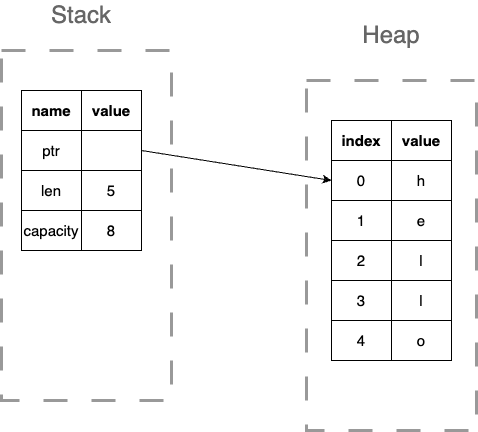
In fact we can inspect the memory layout of a String:
#![allow(unused)]
fn main() {
let mut s = String::from("hello");

println!("&s:{:p}", &s);
println!("ptr: {:p}", s.as_ptr());
println!("len: {}", s.len());
println!("capacity: {}\n", s.capacity());

// Let's add some more text to the string
s.push_str(", world!");
println!("&s:{:p}", &s);
println!("ptr: {:p}", s.as_ptr());
println!("len: {}", s.len());
println!("capacity: {}", s.capacity());
}
Shallow Copy with Move
fn main() {
    let s1 = String::from("hello");
    // s1 has three parts on stack:
    // - pointer to heap data
    // - length: 5
    // - capacity: 5

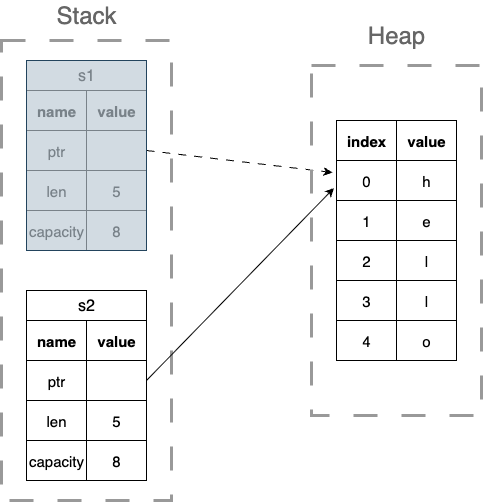
    let s2 = s1;  // shallow copy of stack data

    println!("{}", s1);  // ERROR! s1 is no longer valid
    println!("{}", s2);     // OK
}
Stringstores pointer, length, capacity on stack- Actual string data stored on heap
Shallow Copy:
- Copying the pointer, length, and capacity
- The actual string data is not copied
- The owner of the string data is transferred to the new structure
#![allow(unused)]
fn main() {
let s1 = String::from("hello");

println!("&s1:{:p}", &s1);
println!("ptr: {:p}", s1.as_ptr());
println!("len: {}", s1.len());
println!("capacity: {}\n", s1.capacity());

let s2 = s1;

println!("&s2:{:p}", &s2);
println!("ptr: {:p}", s2.as_ptr());
println!("len: {}", s2.len());
println!("capacity: {}", s2.capacity());
}
The Ownership Rules
- Each value in Rust has an owner
- There can only be one owner at a time
- When the owner goes out of scope, the value is dropped
These rules prevent:
- Double free errors
- Use after free
- Data races
Ownership Transfer: Move Semantics
fn main() {
    let s1 = String::from("hello");
    let s2 = s1;  // ownership moves from s1 to s2

    // s1 is now invalid - compile error if used
    println!("{}", s2);  // OK

    // When s2 goes out of scope, memory is freed
}
- Move prevents double-free
- Only one owner can free the memory
Clone: Deep Copy
fn main() {
    let s1 = String::from("hello");
    let s2 = s1.clone();  // deep copy of heap data

    println!("s1 = {}, s2 = {}", s1, s2);  // both valid
}
clone()creates a full copy of heap data- Both variables are independent owners
- More expensive operation
Vec and the Heap
Vec: Dynamic Arrays on the Heap
What is Vec?
Vec<T>is Rust's growable, heap-allocated array type- Generic over type
T(e.g.,Vec<i32>,Vec<String>) - Contiguous memory allocation for cache efficiency
- Automatically manages capacity and growth
Three ways to create a Vec:
#![allow(unused)]
fn main() {
// 1. Empty vector with type annotation
let v1: Vec<i32> = Vec::new();

// 2. Using vec! macro with initial values
let v2 = vec![1, 2, 3, 4, 5];

// 3. With pre-allocated capacity
let v3: Vec<i32> = Vec::with_capacity(10);
}
Vec Memory Structure
#![allow(unused)]
fn main() {
let mut v = Vec::new();
v.push(1);
v.push(2);
v.push(3);

// Vec structure (on stack):
// - pointer to heap buffer
// - length: 3 (number of elements)
// - capacity: (at least 3, often more)

println!("&v:{:p}", &v);
println!("ptr: {:p}", v.as_ptr());
println!("Length: {}", v.len());
println!("Capacity: {}", v.capacity());

}
- Pointer: points to heap-allocated buffer
- Length: number of initialized elements
- Capacity: total space available before reallocation
Vec Growth and Reallocation
fn main() {
    let mut v = Vec::new();
    println!("Initial capacity: {}", v.capacity());  // 0

    v.push(1);
    println!("After 1 push: {}", v.capacity());      // typically 4

    v.push(2);
    v.push(3);
    v.push(4);
    v.push(5);  // triggers reallocation
    println!("After 5 pushes: {}", v.capacity());    // typically 8
}
- Capacity doubles when full (amortized O(1) push)
- Reallocation: new buffer allocated, old data copied
- Pre-allocate with
with_capacity()to avoid reallocations
Accessing Vec Elements
fn main() {
    let v = vec![10, 20, 30, 40, 50];

    // Indexing - panics if out of bounds
    // Try with index 5 and see what happens
    let third = v[2];
    println!("Third element: {}", third);

    // Using get() - returns Option<T>
    // Safely handles out of bounds indices
    match v.get(2) {
        Some(value) => println!("Third element: {}", value),
        None => println!("No element at index 2"),
    }
}
Option<T>
Option<T> is an enum that can be either Some(T) or None.
Defined in the standard library as:
enum Option<T> {
    Some(T),
    None,
}
Let's you handle the case where there is no return value.
fn main() {
    let v = vec![1, 2, 3, 4, 5];
    // Try with index 5 and see what happens
    match v.get(0) {
        Some(value) => println!("Element: {}", value),
        None => println!("No element at index"),
    }
}
Modifying Vec Elements
fn main() {
    let mut v = vec![1, 2, 3, 4, 5];

    // Direct indexing for modification
    v[0] = 10;

    // Adding elements
    v.push(6);           // add to end

    // Removing elements
    let last = v.pop();  // remove from end, returns Option<T>

    // Insert/remove at position
    v.insert(2, 99);     // insert 99 at index 2
    v.remove(1);         // remove element at index 1

    println!("{:?}", v);
}
Note that
insertandremovecan be expensive operations and are time. On the other hand,pushandpopare time.
Vec Ownership
fn main() {
    let v1 = vec![1, 2, 3, 4, 5];
    let v2 = v1;  // ownership moves

    // println!("{:?}", v1);  // ERROR!
    println!("{:?}", v2);     // OK

    let v3 = v2.clone();      // deep copy
    println!("{:?}, {:?}", v2, v3);  // both OK
}
- Vec follows same ownership rules as String
- Move transfers ownership of heap allocation
Functions and Ownership
Functions and Ownership
fn takes_ownership(s: String) {
    println!("{}", s);
}  // s is dropped here

fn main() {
    let s = String::from("hello");
    takes_ownership(s);
    // println!("{}", s);  // ERROR! s was moved
}
- Passing to function transfers ownership
- Original variable becomes invalid
Returning Ownership
fn gives_ownership(s: String) -> String {
    let new_s = s + " world";
    new_s  // ownership moves to caller
}

fn main() {
    let s1 = String::from("hello");
    let s2 = gives_ownership(s1);
    println!("{}", s2);  // OK
}
- Return value transfers ownership out of function
- Caller becomes new owner
References: Borrowing Without Ownership
fn main() {
    let s1 = String::from("hello");
    let len = calculate_length(&s1);  // borrow with &

    println!("'{}' has length {}", s1, len);  // s1 still valid!
}

fn calculate_length(s: &String) -> usize {
    s.len()
}  // s goes out of scope, but doesn't own data
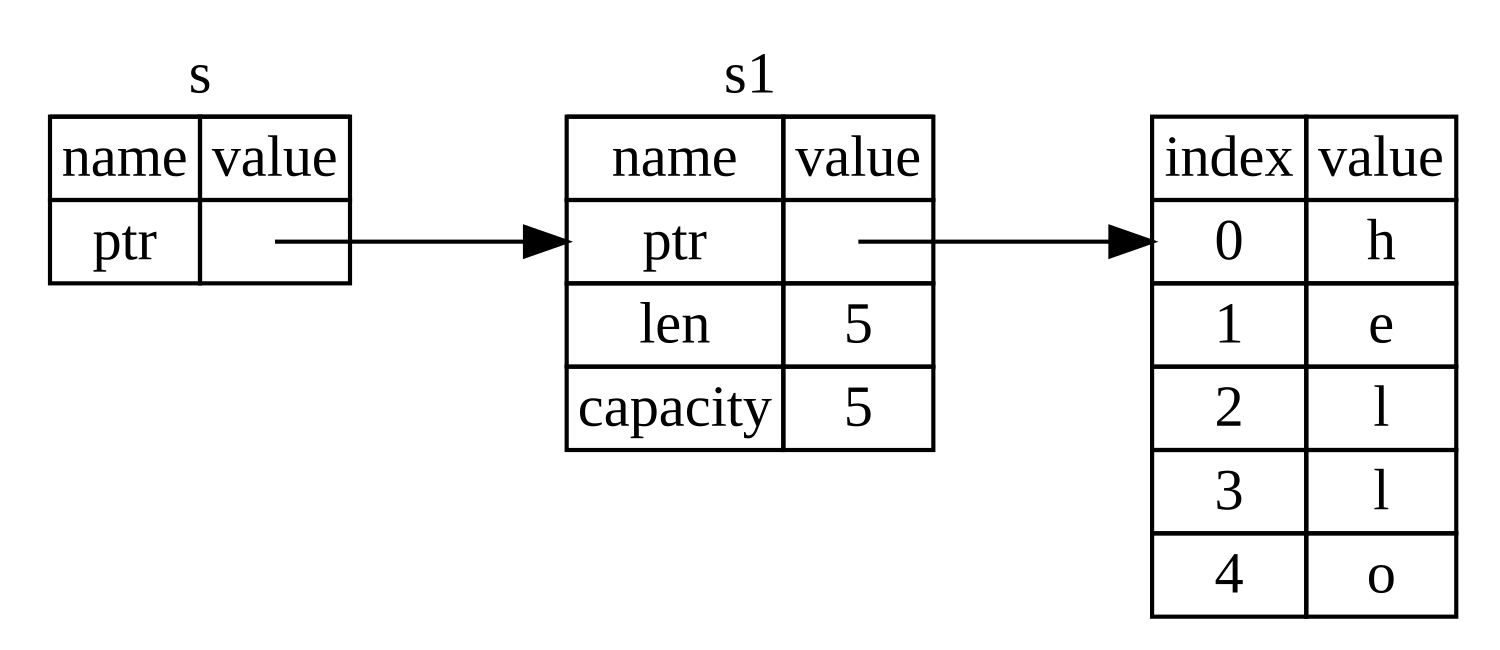
&creates a reference (borrow)- Original owner retains ownership
- Reference allows reading data
Immutable References
fn main() {
    let s = String::from("hello");

    let r1 = &s;  // immutable reference
    let r2 = &s;  // another immutable reference
    let r3 = &s;  // yet another

    println!("{}, {}, {}", r1, r2, r3);  // all valid

    // Let's take a look at the memory layout
    println!("&s: {:p}, s.as_ptr(): {:p}", &s, s.as_ptr());
    println!("&r1: {:p}, r1.as_ptr(): {:p}", &r1, r1.as_ptr());
    println!("&r2: {:p}, r2.as_ptr(): {:p}", &r2, r2.as_ptr());
    println!("&r3: {:p}, r3.as_ptr(): {:p}", &r3, r3.as_ptr());
}
- Multiple immutable references allowed simultaneously
- Cannot modify through immutable reference
// ERROR
fn main() {
    let s = String::from("hello");
    change(&s);
    println!("{}", s);
}

fn change(s: &String) {
    s.push_str(", world");
}
Mutable References
fn main() {
    let mut s = String::from("hello");

    change(&mut s);  // mutable reference with &mut
    println!("{}", s);  // prints "hello, world"
}

fn change(s: &mut String) {
    s.push_str(", world");
}
&mutcreates mutable reference- Allows modification of borrowed data
Mutable Reference Restrictions
fn main() {
    let mut s = String::from("hello");

    let r1 = &mut s;
    let r2 = &mut s;  // ERROR! Only one mutable reference

    println!("{}", r1);
}
- Only ONE mutable reference at a time
- Prevents data races at compile time
- No simultaneous readers when there's a writer
Mixing References: Not Allowed
fn main() {
    let mut s = String::from("hello");

    let r1 = &s;      // immutable
    let r2 = &s;      // immutable
    let r3 = &mut s;  // ERROR! Can't have mutable with immutable

    println!("{}, {}", r1, r2);
}
- Cannot have mutable reference while immutable references exist
- Immutable references expect data won't change
Reference Scopes and Non-Lexical Lifetimes
fn main() {
    let mut s = String::from("hello");

    let r1 = &s;
    let r2 = &s;
    println!("{}, {}", r1, r2);
    // r1 and r2 no longer used after this point

    let r3 = &mut s;  // OK! Previous references out of reference scope
    println!("{}", r3);
}
- Reference scope: from introduction to last use, rather than lexical scope (till end of block)
- Non-lexical lifetimes allow more flexible borrowing
Vec with References
fn main() {
    let mut v = vec![1, 2, 3, 4, 5];

    let first = &v[0];  // immutable borrow

    // v.push(6);  // ERROR! Can't mutate while borrowed

    println!("First element: {}", first);

    v.push(6);  // OK now, first is out of reference scope
}
- Borrowing elements prevents mutation of Vec
- Protects against invalidation (reallocation)
Function Calls: Move vs Reference vs Mutable Reference
fn process_string(s: String) { }         // takes ownership (move)
fn read_string(s: &String) { }           // immutable borrow
fn modify_string(s: &mut String) { }     // mutable borrow

fn main() {
    let mut s = String::from("hello");

    read_string(&s);        // borrow
    modify_string(&mut s);  // mutable borrow
    read_string(&s);        // borrow again
    process_string(s);      // move
    // s is now invalid
}
This is ok because the move (ownership transfer) happens last, so the other references are still valid.
Key Takeaways
- Stack: fixed-size, fast; Heap: dynamic, flexible
- Ownership ensures memory safety without garbage collection
- Move semantics prevent double-free
- Borrowing allows temporary access without ownership transfer
- One mutable reference XOR many immutable references
- References must be valid (no dangling pointers)
- Compiler enforces these rules at compile time
Best Practices
- Prefer borrowing over ownership transfer when possible
- Use immutable references by default
- Keep mutable reference scope minimal
- Let the compiler guide you with error messages
- Clone only when necessary (performance cost)
- Understand whether functions need ownership or just access
In-Class Exercise
Challenge: Fix the Broken Code
The following code has several ownership and borrowing errors. Your task is to fix them so the code compiles and runs correctly.
fn main() {
    let mut numbers = vec![1, 2, 3, 4, 5];

    // Task 1: Calculate sum without taking ownership
    let total = calculate_sum(numbers);

    // Task 2: Double each number in the vector
    double_values(numbers);

    // Task 3: Print both the original and doubled values
    println!("Original sum: {}", total);
    println!("Doubled values: {:?}", numbers);

    // Task 4: Add new numbers to the vector
    add_numbers(numbers, vec![6, 7, 8]);
    println!("After adding: {:?}", numbers);
}

fn calculate_sum(v: Vec<i32>) -> i32 {
    let mut sum = 0;
    for num in v {
        sum += num;
    }
    sum
}

fn double_values(v: Vec<i32>) {
    for num in v {
        num *= 2;
    }
}

fn add_numbers(v: Vec<i32>, new_nums: Vec<i32>) {
    for num in new_nums {
        v.push(num);
    }
}
Hints:
- Think about which functions need ownership vs borrowing
- Consider when you need
&vs&mut - Remember: you can't modify through an immutable reference
- The original vector should still be usable in
mainafter function calls